
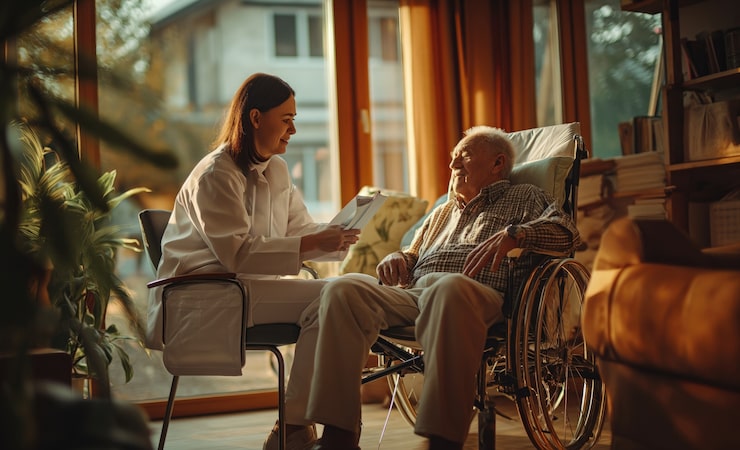
— For People Searching Right Now For most dementia patients, live-in care at home consistently delivers better outcomes than a residential care home. Research shows that familiar environments slow cognitive decline, reduce anxiety and behavioural symptoms, and improve quality of life. Live-in Care Direct provides specialist dementia care at home across Yorkshire, London, and the whole of the UK — often at a comparable cost to a care home.
When a loved one receives a dementia diagnosis, one of the most difficult and consequential decisions a family will face is this: should they stay at home with professional support, or move into a residential care home?
It is a question asked by thousands of families across Yorkshire, London, Manchester, Birmingham, and every corner of the United Kingdom every single year. And it is a question that deserves a genuinely honest, evidence-based answer — not a sales pitch, not a simplification, but a thorough guide that helps you make the right choice for your loved one.
In this guide, we compare live-in care at home and residential care homes across every dimension that matters: quality of care, dementia outcomes, emotional wellbeing, cost, flexibility, safety, and more. We will also tell you clearly when a care home may be the right choice — because our commitment is to your loved one’s best interests, not to a particular outcome.
Let us start with the evidence.

What Does the Evidence Say? Dementia Care at Home vs Care Home
The clinical evidence on dementia care settings is substantial — and it points consistently in one direction.
A landmark study published in the British Medical Journal found that people with dementia who received skilled care at home demonstrated significantly slower cognitive decline over a 12-month period compared to those in residential care settings. The researchers attributed this primarily to the role of familiar environments in maintaining neural pathways and reducing the stress response associated with unfamiliar surroundings.
The Alzheimer’s Society, one of the UK’s foremost dementia authorities, states clearly that people with dementia often experience significant distress when moved to a new environment. The organisation notes that behavioural symptoms — including agitation, aggression, wandering, and sleep disturbance — frequently worsen following a move to residential care, particularly in the early and middle stages of the condition.
This is not a criticism of care homes. Many provide excellent care and are the right choice for some individuals at certain stages of dementia. But the evidence is clear: for the majority of dementia patients who are not yet in the late stages of the condition, remaining in a familiar home environment with skilled one-to-one support produces better clinical and emotional outcomes.
| ✅ Expert TipThe single most important environmental factor for dementia patients is familiarity. The sounds, smells, layout, and objects in a person’s own home act as constant, gentle cognitive anchors — helping to orient and calm a person with dementia in ways that even the most well-designed care home cannot replicate. |
Understanding Dementia: Why the Care Setting Matters So Much
How Dementia Affects the Brain
Dementia is not a single condition — it is an umbrella term for a group of progressive neurological conditions that affect memory, thinking, behaviour, and the ability to perform everyday tasks. The most common forms include Alzheimer’s disease (which accounts for 60–70% of all dementia cases), vascular dementia, Lewy body dementia, and frontotemporal dementia.
What all forms of dementia share is this: the brain’s ability to process and adapt to new information and environments is significantly impaired. This is why change — particularly a change of living environment — can be so profoundly destabilising for someone living with dementia.
When a person with dementia moves into a care home, they must suddenly navigate an entirely new set of sensory inputs: unfamiliar rooms, unfamiliar faces, unfamiliar routines, unfamiliar smells. For a brain that is already struggling to process information, this level of novelty can trigger a dramatic worsening of symptoms — a phenomenon sometimes called ‘transfer trauma’ or ‘relocation stress syndrome.’
In a person’s own home, none of this applies. The environment is deeply known and reassuring. The layout is automatic. The sounds are familiar. The objects are meaningful. This environmental familiarity has a measurable calming effect on the dementia brain — and it is one that no care home, however excellent, can fully replicate.
The Three Stages of Dementia and What Each Needs
| Stage | Typical Needs | Best Care Setting |
| Early Stage (Mild symptoms) | Prompting with daily tasks, medication management, companionship, safety monitoring, cognitive stimulation | Home with live-in care — strongly recommended |
| Middle Stage (Moderate symptoms) | Personal care assistance, mobility support, managing behavioural symptoms, 24/7 supervision, nutrition support | Home with specialist live-in carer — highly effective |
| Late Stage (Severe symptoms) | Intensive nursing care, full personal care, palliative support, complex medical needs | Home with live-in nurse/carer OR specialist nursing home |
As the table above shows, live-in care at home is the recommended setting across the early and middle stages of dementia — which together can span many years. Only in the very late stages, when complex nursing needs arise, does a specialist nursing care home sometimes become appropriate.
Live-in Care for Dementia: What It Involves
Live-in dementia care means a professionally trained carer moves into your loved one’s home and provides dedicated, one-to-one support around the clock. Unlike hourly care visits — where a carer arrives for 30 or 60 minutes and then leaves — a live-in carer is always present, always available, and always consistent.
At Live-in Care Direct, our specialist dementia carers provide the following across Yorkshire, London, the North West, Scotland, Wales, and every other region of the UK:
Personal Care and Daily Routines
Our dementia carers assist with all personal care tasks — bathing, dressing, oral hygiene, continence care, and grooming — while preserving as much independence and dignity as possible. Critically, they maintain the individual’s existing routines, which is profoundly important for dementia patients. A consistent daily structure — the same morning routine, the same mealtimes, the same evening ritual — provides a framework of predictability that significantly reduces anxiety and confusion.
Medication Management
Medication adherence is one of the most critical — and most frequently missed — aspects of dementia care at home. As dementia progresses, individuals become increasingly unable to manage their own medications. Our carers administer all medications accurately and on time, maintain detailed medication records, and liaise with GPs and community pharmacists across Yorkshire and the wider UK.
Cognitive Stimulation and Meaningful Activity
Cognitive stimulation is one of the most evidence-backed interventions for slowing the progression of dementia. Our carers engage their clients in meaningful activities tailored to their personal history and interests — whether that is gardening in a Yorkshire garden, looking through family photo albums, listening to favourite music, doing gentle crafts, or simply sharing conversation about cherished memories. These activities are not merely ‘time fillers’ — they are clinically valuable interventions.
Behavioural Symptom Support
Behavioural and psychological symptoms of dementia (BPSD) — including agitation, sundowning, wandering, repetitive behaviours, and sleep disturbance — affect the vast majority of people with dementia at some point. Our carers are trained in evidence-based, non-pharmacological approaches to managing these symptoms: validation therapy, distraction techniques, sensory stimulation, and environmental modification. This specialised training is what distinguishes a skilled dementia carer from a general carer.
Family Communication and Emotional Support
Dementia is as hard on the family as it is on the person diagnosed. Our carers provide regular updates to family members, use Live-in Care Direct’s secure digital care management platform to log observations and share reports, and offer emotional support and practical guidance throughout the journey.
Safety and 24/7 Monitoring
Safety is paramount. Our live-in dementia carers monitor for falls, wandering, medication errors, nutritional decline, and signs of infection or physical health deterioration — 24 hours a day, 7 days a week. Our state-of-the-art technology platform adds an additional layer of safety monitoring, ensuring families across Yorkshire and the UK can have complete confidence in their loved one’s wellbeing at all times.

What Does a Dementia Care Home Provide?
In the interests of a genuinely fair comparison, it is important to present what residential care homes for dementia patients offer — because many provide good care and are the right choice for some individuals.
A specialist dementia care home typically provides:
• 24-hour staffing (though rarely one-to-one ratios — typically 1 carer to 6–8 residents during the day)
• Purpose-designed dementia environments (including secure gardens, sensory rooms, and memory boxes)
• Structured activity programmes (arts, music, reminiscence groups)
• On-site nursing and medical support
• Peer socialisation with other residents
• Specialist dementia training for care staff
• CQC regulation and inspection
The genuine strengths of a dementia care home are its structured environment, peer socialisation opportunities, and on-site medical support. For individuals with very complex medical needs in the late stages of dementia, these can be significant advantages.
However, care homes also carry well-documented challenges for dementia patients — which we address in the comparison section below.
| ⚠ Important WarningCommon Mistake: Many families choose a care home for their loved one with dementia in the belief that it is ‘safer’ than staying at home. In reality, the risk of falls, infections (particularly UTIs and chest infections), and rapid cognitive decline is statistically higher in institutional care settings than in well-managed home environments. Professional live-in care at home is not a less safe option — it is frequently the safer one. |
Live-in Care vs Care Home for Dementia: The Full Comparison
Below is a comprehensive, honest comparison across every dimension that matters to dementia patients and their families.
| Category | Live-in Care at Home | Residential Care Home |
| Carer Ratio | 1-to-1 dedicated carer — full individual attention | Typically 1 carer to 6–8 residents — shared attention |
| Consistency of Carer | Same carer every day — deep knowledge of the individual | Rotating shift staff — no consistent relationship |
| Environment | Familiar home — powerful cognitive anchor for dementia | Unfamiliar environment — risk of relocation trauma |
| Routine | Fully personalised — client’s existing routines maintained | Standardised home routines — limited personalisation |
| Cognitive Stimulation | Tailored daily activities based on personal interests | Group activities — not individually tailored |
| Family Involvement | Family visits any time, full involvement in care | Visiting hours may be restricted; less family contact |
| Dietary Choice | Meals cooked to personal preference, diet, and culture | Set menus — limited dietary personalisation |
| Independence | Maximum independence preserved within safe limits | Institutional environment reduces independent choices |
| Dementia Outcomes | Clinical evidence favours home environment for slower decline | Higher rates of behavioural symptoms post-admission |
| Safety (Falls) | One-to-one supervision significantly reduces fall risk | Shared supervision — falls remain a leading risk |
| Infection Risk | Low — individual home environment | Higher — shared spaces, communal dining, group activities |
| Emotional Wellbeing | Strong — familiar home, consistent carer, family nearby | Variable — unfamiliar setting can cause distress |
| Pets / Garden / Home | Full access to beloved home, garden, and pets | Usually not possible to bring pets or personal items |
| Flexibility | Care plan adapts daily to changing needs | Standardised care plan — less flexible |
| CQC Regulation | Regulated care agency — CQC standards apply | CQC registered and inspected residential facility |
| Cost (approx.) | £900–£1,500/week depending on care complexity | £800–£1,800/week depending on location and type |
| NHS Funding | NHS CHC funding fully available for eligible individuals | NHS CHC and NHS-FNC funding available |
| Speed of Arrangement | Often within 24–48 hours (Live-in Care Direct) | Waiting lists for quality homes are common |
| ✅ Expert TipThe most striking finding in this comparison is the carer-to-resident ratio. In a care home, each member of staff typically looks after 6 to 8 residents simultaneously. With live-in care, every single moment of care is focused exclusively on your loved one. For a condition like dementia — where individual attention, consistent relationships, and personalised stimulation are clinically proven to make a difference — this ratio advantage is enormous. |
The Emotional Case: Why Familiarity Is Medicine for Dementia
Beyond the clinical data, there is a deeply human case for live-in care that families across Yorkshire, London, and the rest of the UK consistently express to us.
Home is not just a building. For a person with dementia, home is the accumulated meaning of a lifetime. The armchair by the window. The garden they have tended for forty years. The kitchen where they have made a thousand meals. The photographs on the mantelpiece. The familiar creak of the third stair.
All of these things are not merely sentimental — they are powerful cognitive anchors that help a person with dementia to remain oriented, calm, and connected to their own identity even as the condition progresses.
When these familiar anchors are removed — as they inevitably are in a move to a care home — many people with dementia experience a sudden and sometimes irreversible worsening of their symptoms. We have spoken with many Yorkshire and London families who describe their loved one as having changed dramatically within weeks of entering a care home, in ways they had not expected and were not prepared for.
This is not a universal outcome, and some individuals adapt well to residential care. But the risk of this deterioration is real, it is documented, and it is one of the most compelling reasons why families choose live-in dementia care at home.
| Real Family Example — Leeds, YorkshireMargaret, 79, was diagnosed with Alzheimer’s disease in 2022. Her family in Leeds initially considered a care home, concerned about her safety at home. After speaking with Live-in Care Direct, they opted for a specialist live-in dementia carer instead. Three years later, Margaret remains in her own home of 45 years. Her family report that she continues to recognise family members, engages actively with her carer in daily activities, and remains far more communicative than they had feared she would be at this stage. Her GP has noted that her cognitive decline has been slower than clinically predicted. “The carer knows Mum better than anyone now. She knows what upsets her, what delights her, what makes her laugh. No care home could have given her that.” — Margaret’s daughter, Leeds |
How Much Does Dementia Care Cost — Live-in Care vs Care Home?
Cost is one of the most significant factors for families making this decision, and it is important to address it honestly.
The perception that live-in care is significantly more expensive than a care home is a misconception that persists — and it frequently leads families to choose care homes without properly investigating the alternative. In reality, the costs are often comparable, and for many families, live-in care is the more affordable option when all factors are considered.
Approximate Weekly Costs in the UK (2025)
| Care Type | Approximate Weekly Cost |
| Live-in dementia care at home | £900 – £1,500 per week |
| Residential dementia care home | £800 – £1,200 per week |
| Specialist nursing dementia home | £1,100 – £1,800 per week |
| Hourly dementia home visits (3x daily) | £420 – £630 per week (often insufficient) |
As the table shows, live-in care at home sits squarely within the same price range as residential care — and at the upper end, a specialist nursing care home in London or the South East can cost significantly more than live-in care at home. When the superior one-to-one care ratio, personalisation, and clinical outcomes of live-in care are factored in, many families conclude it represents substantially better value for money.
Who Pays for Dementia Care in the UK?
This is one of the most important questions we help families navigate — and the answer is more nuanced than most people realise.
1. NHS Continuing Healthcare (CHC) — If your loved one’s dementia has created a ‘primary health need’, the NHS is legally required to fund all of their care costs — including live-in care at home. Many families across Yorkshire and the UK miss out on this funding simply because they were never told it exists. Always request a formal CHC checklist screening before making any financial arrangements.
2. Local Authority Funding — Yorkshire councils (Leeds City Council, Sheffield City Council, Bradford Council, etc.) and local authorities across the UK provide means-tested care funding for those with assets below £23,250 in England. A free needs assessment from the council is the first step.
3. NHS-Funded Nursing Care (FNC) — A weekly contribution from the NHS (currently £235.88/week in England) toward the nursing element of care, applicable where live-in care involves nursing needs.
4. Attendance Allowance — An often-overlooked benefit available to people over 65 who need help with personal care due to a physical or mental disability. Currently up to £108.55/week (2024/25). Does not depend on National Insurance record or savings.
5. Direct Payments — Instead of receiving council-arranged care, families can opt to receive the care budget as a direct cash payment and use it to hire their own carer — giving full control over who provides the care.
6. Self-Funding — For those who do not qualify for funded care, self-funding live-in dementia care is a straightforward option. Live-in Care Direct provides transparent, all-inclusive pricing with no hidden fees.
| ⚠ Important WarningNever assume your loved one does not qualify for NHS Continuing Healthcare funding. The CHC checklist is free, it is your legal right to request it, and it can save families tens of thousands of pounds. Always ask your GP, social worker, or hospital discharge team to arrange a CHC checklist screening — before spending a single pound of your own money on care. |

Dementia Care Across Yorkshire and the Wider UK
Dementia Care in Yorkshire
Yorkshire has one of the highest proportions of older residents of any UK region, and dementia affects a significant number of Yorkshire families every year. Live-in Care Direct provides specialist dementia care across all of Yorkshire’s major cities and surrounding areas:
• Leeds — live-in dementia care across all Leeds postcodes and surrounding areas
• Sheffield — specialist Alzheimer’s and dementia care in Sheffield
• Bradford — live-in dementia carers available throughout Bradford
• York — dementia care at home in York and the surrounding villages
• Hull — specialist dementia support across Kingston upon Hull
• Harrogate — live-in dementia care in Harrogate and Knaresborough
• Wakefield, Doncaster, Rotherham, Barnsley, Huddersfield, and all surrounding towns
Our Yorkshire team understands the local NHS landscape — including Yorkshire and Humber Academic Health Science Network dementia pathways, and local authority care commissioning across Leeds, Sheffield, Bradford, and East Riding councils. We work closely with Yorkshire GP practices, memory clinics, and community mental health teams to ensure seamless, coordinated care.
Dementia Care Across the UK — Every Region Covered
Live-in Care Direct provides specialist dementia care at home across the entire United Kingdom:
| Region | Key Areas Covered |
| London | All 32 London boroughs — Central, North, South, East, West London |
| South East | Surrey, Kent, East & West Sussex, Hampshire, Berkshire, Oxfordshire |
| East Midlands | Nottingham, Leicester, Derby, Lincoln, Northampton |
| North East | Newcastle, Sunderland, Durham, Middlesbrough, Gateshead |
| North West | Manchester, Liverpool, Preston, Chester, Blackpool, Lancaster |
| South West | Bristol, Bath, Exeter, Plymouth, Cheltenham, Gloucester |
| Wales | Cardiff, Swansea, Newport, Wrexham, Bridgend |
| West Midlands | Birmingham, Coventry, Wolverhampton, Stoke-on-Trent |
| Essex | Chelmsford, Colchester, Southend-on-Sea, Harlow, Basildon |
| East of England | Cambridge, Norwich, Ipswich, Luton, Peterborough |
| Scotland | Edinburgh, Glasgow, Aberdeen, Inverness, Dundee |
| NoteWherever you are in the UK, Live-in Care Direct can arrange specialist dementia care at home — typically within 24 to 48 hours of your first call. |
When Is a Care Home the Right Choice for Dementia?
We promised an honest guide — and honesty requires us to address this question directly.
For most people with dementia, and at most stages of the condition, live-in care at home is the better choice. But there are specific circumstances in which a specialist dementia nursing home becomes the more appropriate option:
7. Very late-stage dementia with complex medical needs — When a person requires continuous nursing intervention beyond the scope of a live-in carer (for example, complex wound care, intravenous medication, or specialist neurological nursing), a nursing care home may be more appropriate.
8. Extremely challenging behavioural symptoms — In rare cases, dementia produces behaviour that poses a serious risk to the person or others, requiring secure specialist dementia facilities that cannot be replicated at home.
9. Severe social isolation risk — For individuals who live alone, have no family nearby, and whose dementia means they would find a live-in carer’s presence distressing, a care home’s social environment can sometimes be more beneficial.
10. Family caregiver crisis — In some emergency situations, where no live-in care can be arranged quickly enough and the person cannot be safely left, a short-term residential placement may be necessary while longer-term live-in care is organised.
Even in these cases, it is worth considering whether the situation might change. Short-term residential respite care whilst live-in care is arranged is often a better solution than a permanent care home placement made under pressure.
| ✅ Expert TipIf you are considering a permanent care home placement, first request a short-term respite trial. This gives your loved one time to adjust (or not), gives you time to see how they respond, and preserves the option of returning home with live-in support if the care home does not suit them. |
Prevention: Keeping Dementia Patients Safer at Home
One concern families frequently raise about dementia care at home is safety — specifically the risk of falls, wandering, and accidents. These are entirely legitimate concerns, and addressing them proactively is a core part of what our dementia carers do.
Home Safety Adaptations for Dementia Patients
• Install grab rails in bathrooms, along hallways, and on stairways
• Remove trip hazards — loose rugs, trailing cables, cluttered pathways
• Fit a keypad or alarm on external doors to prevent unsupervised wandering
• Use a personal emergency alarm or GPS tracker device
• Install night lights along the route from bedroom to bathroom
• Label cupboards and rooms clearly with pictures and words
• Remove or lock away hazardous items (cleaning products, sharp implements, medications)
• Consider a hospital-grade adjustable bed if mobility is compromised
Yorkshire and other UK local councils can provide some adaptations free of charge through the Disabled Facilities Grant (DFG), which offers up to £30,000 for eligible home modifications. Our team can advise families on accessing this funding.
How Our Carers Prevent Dementia-Related Accidents
A live-in dementia carer is the single most effective safety intervention available. Unlike passive sensors or alarm systems, a trained carer can anticipate risks, intervene in real time, and adapt the environment continuously as the person’s needs change. Our carers are trained in dementia-specific risk assessment, fall prevention, fire safety, and emergency response procedures.
When to Call a Professional Dementia Care Provider
Knowing when to reach out for professional dementia care support is one of the most important decisions a family can make. Here are the situations in which we would encourage you to contact Live-in Care Direct without delay:
11. Your loved one has recently received a dementia or Alzheimer’s diagnosis and you are planning ahead for future care needs.
12. You are providing unpaid care yourself but noticing signs of carer burnout — exhaustion, resentment, anxiety, or your own health declining.
13. Your loved one is having falls, wandering at night, missing medications, or showing signs of rapid cognitive decline.
14. Your loved one has expressed clearly that they do not want to go into a care home.
15. You are being told by a hospital or GP that your loved one needs more care than the NHS can currently provide.
16. You have visited care homes and found the options available unsatisfactory, too expensive, or too far from the family.
17. You need emergency dementia care arranged urgently — within 24 hours.
| We Are Here 8am–10pm, 7 Days a WeekCall 0800 368 8558 or email info@liveincaredirect.org. Our dementia care specialists will listen, advise, and help you find the right solution — without pressure, without obligation, and at no cost. |
Why Choose Live-in Care Direct for Dementia Care?
Specialist Dementia Expertise
Not all live-in care agencies have genuine specialist dementia expertise. At Live-in Care Direct, we carefully select and match dementia carers based on their specific training, experience, and personality. We look for carers who have not just completed a dementia training course, but who have years of hands-on experience supporting people with Alzheimer’s, vascular dementia, Lewy body dementia, and other forms of the condition.
The Power of One-to-One, Consistent Care
Everything in dementia care comes back to one principle: consistency. The same carer, the same face, the same voice, the same routine — every single day. Our carers build deep, meaningful relationships with their clients that go far beyond task completion. They become trusted companions, advocates, and a genuine source of stability in a world that dementia can make increasingly confusing.
Technology That Keeps Families Informed
Live-in Care Direct has invested heavily in secure, state-of-the-art care management technology. Families across Yorkshire, London, and the whole of the UK can access real-time care notes, progress updates, medication logs, and carer reports through our digital platform — giving complete transparency and peace of mind, wherever they are.
Rapid Arrangement — Often Within 24 to 48 Hours
Dementia care needs can arise suddenly — following a hospital admission, a rapid change in the condition, or a family carer crisis. Our extensive database of qualified, vetted dementia carers across the UK means we can respond quickly. In most cases, we can arrange a specialist dementia carer within 24 to 48 hours of your first contact.
Honest, Transparent Pricing — No Hidden Fees
We provide a written, all-inclusive quote before any care begins. No registration fees, no placement fees buried in the small print, no unexpected additional charges. Our pricing is straightforward and fair — because families dealing with a dementia diagnosis have enough to worry about without financial surprises.
Nationwide Coverage — Every Region of the UK
From Yorkshire and London to Scotland, Wales, the South West, and Essex — Live-in Care Direct covers the entire United Kingdom. Wherever your family is based, we can arrange specialist dementia care at home.
| Get Expert Dementia Care Advice — Free & No ObligationSpeak to a specialist dementia care coordinator today. We cover Yorkshire, London, and every region of the UK. 📞 0800 368 8558 | 📧 info@liveincaredirect.orgliveincaredirect.org/our-services/dementia-care.php |
Dementia is one of the most challenging journeys a family can face. But with the right professional support — delivered in the right environment — your loved one can continue to live with dignity, comfort, and meaning in the place that matters most to them: home.
Do not wait until a crisis forces a rushed decision. Call Live-in Care Direct today — and let us help your family take the next step with knowledge, confidence, and compassion.
Local FAQs — Live-in Care vs Care Home
Q1: Is live-in care better than a care home for dementia patients?
For most dementia patients — particularly in the early and middle stages — live-in care at home consistently produces better outcomes than residential care, because familiar environments slow cognitive decline, reduce behavioural symptoms, and preserve quality of life in ways that institutional settings cannot match.
Q2: Can someone with dementia be cared for at home in Yorkshire?
Yes — the vast majority of people with dementia in Yorkshire can be safely and effectively cared for at home with a trained live-in dementia carer, often for many years, and Live-in Care Direct can arrange specialist dementia care across Leeds, Sheffield, York, Bradford, Hull, and all surrounding areas.
Q3: How much does dementia care cost in Yorkshire?
Live-in dementia care in Yorkshire typically costs between £900 and £1,500 per week depending on the complexity of care required, which is often comparable to or less than the cost of a residential dementia care home, and NHS Continuing Healthcare funding may cover all costs for eligible individuals.
Q4: Who pays for dementia care at home in Yorkshire?
Dementia care at home in Yorkshire can be funded through NHS Continuing Healthcare (for those with a primary health need), local authority means-tested funding through Yorkshire councils, Attendance Allowance, Direct Payments, or private self-funding — always request a CHC assessment before paying privately.
Q5: What is the difference between live-in dementia care and hourly home care?
Live-in dementia care means a trained carer lives in the home and provides round-the-clock one-to-one support, while hourly home care involves brief visits of 30–60 minutes with the person left unsupervised the rest of the time — making live-in care significantly safer and more effective for dementia patients with moderate to complex needs.
Q6: What support is available for dementia patients in Yorkshire?
Dementia patients in Yorkshire can access NHS memory clinics, Yorkshire community mental health teams, the Alzheimer’s Society’s local groups in Leeds and Sheffield, Age UK West Yorkshire, and private live-in care agencies like Live-in Care Direct for 24/7 specialist home-based support.
Q7: How quickly can Live-in Care Direct arrange dementia care at home?
Live-in Care Direct can typically arrange a specialist dementia carer at home anywhere in Yorkshire or the UK within 24 to 48 hours of initial contact, making us a reliable option for urgent dementia care situations including emergency hospital discharge or sudden carer unavailability.